Thursday, May 8, 2014

The Third Apocalyptic Friday

Hello scientists!

I'll get right to the point. We've all seen or heard those movies or conspiracy theroies about the Large Hadron Collider (or LHC) creating a black hole that will destory the Earth. Will it? Let's find out.

First of all, what is the LHC? The Large Hadron Collider is, in its simplest, two pipes shaped like an enormous circle underground. Two small things, such as atoms, are sped down these tubes in opposite directions near the speed of light. When scientists want to, they make one particle move to the other pipe, smashing them together with enormous force, seperating the atoms into its simpliest parts, useful for research. It has a 17 mile diameter and looks like this if it was aboveground:
We're worried about the atoms creating enough energy to kill off the Earth via black hole. First of all, let's make sure there's enough energy to create one.

Let's make something clear first. Atoms almost never actually touch. If you're sitting down right now, magnetic forces in between atoms repel each other, making a microscopic space between you and the chair you're sitting on. However, this isn't the case with the LHC. The atoms collide at almost twice the speed of light, forcing them closer than they usually get. The tiny force of gravity between the atoms then pulls them together and make them physically touch. This gives off much more energy than expected: enough to make a black hole.

So we can make a black hole (although it's an incredibly tiny one). Not a great start. Luckily, the man Stephan Hawking came to the rescue. He calculated that black holes give off radiation. If the black hole is too small, it overexerts itself by releasing too much radiation for its size and evaporates. We have a microscopic black hole; is that small enough? Well, the smallest possible stable black hole is about three times bigger than our Sun. So any black holes would dissipate if LHC made one, unless you want to question a widely accepted theory proposed by Steven Hawking. Only an idiot would do that

But we are idiots on this blog, so let's question it anyway. What would happen if one somehow stayed alive? Well, the energy made by the atomic collision was so strong that it would probably propel the black hole away from Earth and into space. About one out of one million black holes would be moving slowly enough to hang on to Earth's atmosphere.

What then, in case I somehow haven't assured you enough? Well, as gravity pulls things toward Earth's center, the black hole would obviously go to Earth's center. There it would stay, picking Earth away at a rate of a proton every 4 days. By the end of the universe's life, it will have only consumed a few milligrams of the inner core.

So there you have it. The Earth will lose .00000000000000000000002 pounds in your lifetime, but only in a one in a million chance, and only if Steven Hawking is wrong, and only if scientists at the LHC aren't careful. And they are.

Thanks for reading! Also, I always say this causally, but I really want to thank John from John's Math Blog for a shout-out to my blog. I will return the favor, but not because I owe him one, but because it's actually really interesting. If you like my stuff, you'll probably like what he has to say as well. Anyway, make sure to comment below, and I'll see you in the next post!

Until next time,
Ben's jamin'
Benjamin

Wednesday, May 7, 2014

Myths Rundown

Hello scientists!

Last time, I said that we were going to talk about physics, but I changed my mind. Physics will be next, though! Instead, let's go over some common misconceptions.

1. The Great Wall of China is claimed to be the only man-made structure visible from the Moon. This is wrong for two reasons. The first is that you can't see it when you're higher than 180 miles, much closer than the Moon. Although it is longer than 13,000 miles, it is only 30 feet wide, putting it at a great disadvantage. The second reason the myth is wrong is that there are many man-made things visible from the Moon, such as city lights. This is what it looks like from a low-Earth orbit:

And no, it's not that line running from top-left to bottom-right; that's a river. The wall runs from bottom-left to top-right. If you can barely see it, this picture is also zoomed in from a satellite that is no where close to the Moon.
2. As we all know, bulls hate the color red. Except they don't. Red isn't even a bright color to cattles' eyes. They instead charge the matador because they appear as a potential threat.

3. Pennies falling from the Empire State Building are feared of killing someone on the ground. However, there's a scientific principle called terminal velocity. This is when the drag, or air resistance, on something falling is as strong as gravity. This results on the object neither slowing or speeding up. The terminal velocity of a penny is 30-50 mph. At this speed, a penny won't have enough velocity to crack the human skull. Granted, it will hurt, but you'll survive.

4. This one is actually one that proves me wrong. The heating of a meteor is not actually caused by air rubbing against it, but air compressing in front of the meteor. So I was wrong about those Russian meteors from two entries ago.

5. Black holes are often thought to be violent eaters of the universe. That's true, but only if the objects are very close to it. After all, if they have the same mass as a star, they will have the same gravitational pull. In fact, if the Sun was replaced by a black hole with the same mass, Earth wouldn't notice (except humans would). The only difference is that a black hole is a lot denser.

6. Not all worms that are cut in half produce two new worms. The front half will usually live with its mouth, while the rear half will die. However, some flatworms can actually produce two worms from two halves, known scientifically as anterior regeneration.

7. This one may be the most surprising of all. For years I've likced ice cream only with the tip of my tongue to taste the most sweetness. As we've all seen at one point or another, different parts of the tongue are used to taste different things, such as sweetness and spiciness. Apparently, that actually isn't true. If you recognize this:

you know what I'm talking about. Turns out that every part of the tongue can detect each primary taste almost as well as the others, although it may differentiate from person to person. To add to that, the locations of sensitivity are never the same, and there are actually five primary tastes, not four. The fifth is called umami, used to describe tastes such as meat.

8. Speaking of senses, we often think that we have five senses: sight, taste, scent, touch, and sound. We actually have much more than that, including, but not limited to: balance, acceleration, pain, body position, temperature, time, itching, pressure, hunger, thirst, when to stop eating, when to go #1 and #2, and the most famous one of all, carbon dioxide levels in the blood.

9. Sugar doesn't make people hyper, especially children. In tests, children were both given sugar-free soda and soda with sugar that tasted and looked exactly the same. After the test, both children behaved the same and had the same amount of energy.

10. As you may have guessed by now, humans don't just use 10% of their brain. This can be simply proven with an MRI. The brain is incredibly complex, but one things scientists do know is that it uses more than 10% of it's neutrons. This source of this myth can be traced back to philosopher William James, who used the phrase metaphorically.

Thanks for reading! Make sure to comment below! As I mentioned, I promised something physics related and Apocalyptic Friday is coming up, so I'm thinking I'll just combine the two. Tune in then!

Until next time,
Ben's jamin'
Benjamin


P.S. Make sure you check out John's math blog at http://johncooksmathblog.blogspot.com.

Tuesday, May 6, 2014

The Best Animal Ever

Hello scientists!

It's obvious that humans rule the Earth now, but there is an animal that can survive a lot more than we can. It has survived almost every test we have performed on them, and most of us don't even know they exist. They are called tardigrades.

They look like aliens. They are tiny (1/50th of an inch), have eight legs, and kind of chubby. Here's a picture of them:
Pretty strange, huh?

Anyway, they are considered extremophiles, which are organisms that can live in conditions that would kill most other life forms. How tough is this "water bear"? Let's take a look.

How do they fare in the heat and cold? Well, they have been heated to 304 degrees Fahrenheit for a few minutes. To cool them off, scientists then placed them in a chamber cooled to -324 degrees Fahrenheit for days. Some were even able to survive at -428 degrees for a few minutes, just above the lowest physically possible temperature. A+.

What about pressure? Many deep sea fish are constantly pushing outward to compensate for the water pressure. When they are brought up to the surface, they still push their bodies outward, causing them to explode with no water pressure. Tardigrades are different story. They have survived being in a vacuum for 10 days without exploding (like the fish), and have had survived 6,000 times the pressure of the Earth's atmosphere, or the equivalent of six times the water pressure of the deepest point in the ocean. A+ again.

Camels can survive a long time without water. As famous as they are, they are put to shame by tardigrades. These little guys can go 10 whole years without water and survive. A leg twitch (which isn't really considered survival, but still) has been observed 120 years without water. A++.

Chernobyl is one of the world's most deadly nuclear disasters. It is still not safe to be around due to radiation. Tardigrades don't care. Surviving 1,000 times more radiation than other animals, scientists aren't sure how they do it. One explanation is that their low hydration (possible because they can survive without water for a while) ionizes the radiation, rendering it harmless. A+ again!

For its final act of survival, it will try to survive the most dangerous enviornment of all. As I've mentioned, it can survive a lot a radiation, and it can survive in a vacuum. Sounds like outer space to me. With an extreme change of pressure and no ozone layer to block radiation, the most hostile environment is no environment at all. Dehydrated tardigrades were sent into a low Earth orbit. Surprisingly, 68% of them survived. Pretty amazing. A+ for all of them.

Thanks for reading! Make sure to comment below as well! Next time, let's tackle a physics topic, shall we? Tune in then!

Until next time,
Ben's jamin'
Benjamin

P.S. Make sure you check out John's math blog at http://johncooksmathblog.blogspot.com.

Sunday, May 4, 2014

The Second Apocalypse Friday

Hello scientists!

I'm sorry for not updating my blog recently. In the future, I will try to be better about doing something every day, or at least something close to it. So, without further ado, today's entry!

Today is Sunday, but this is going to be an apocalyptic blog. This topic is more related to astronomy than geology, like last time. This event has also happened before, and when it did, it wiped out Earth's dominant species. Asteroids!

The impact that we remember is the one that occurred in Russia on February 15, 2013. The damage didn't come from the meteor hitting the Earth, but rather an explosion caused by the friction of the meteor traveling through the atmosphere. Even so, the energy released was equivalent to 500 kilotons tons of TNT, or about 25 times more powerful than Little Boy, the bomb dropped on Hiroshima.

The most powerful strike in recorded history happened in Russia as well (I know, they have bad luck). Known as the Tungunka event, its destruction was caused by the meteor bursting in mid-air rather than colliding with the ground. The explosion that occurred on June 30th, 1908 released the same energy as 30 megatons of TNT, or 1,000 times greater than Little Boy, which was enough to flatten around 80 million tress around the impact site.

However, the most powerful impact ever has probably happened about 3.26 billion years ago. The meteor was probably about 30 miles wide.,  Scientists have only found evidence of the impact in South Africa in 2014. However, an actual crater has not been found yet.

So what's next? Well, an asteroid five miles or wider would trigger another mass extinction, like with the dinosaurs. The scary part? The Kuiper Belt, a ring of objects just beyond Neptune, contains about 100,000 objects more than 50 miles in diameter, many of which fall toward the Sun every year. Yikes.

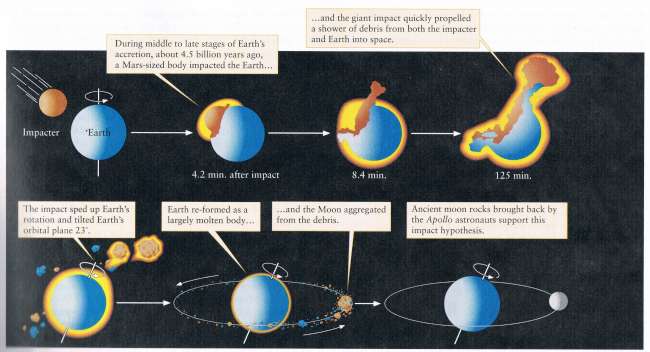
On one last note, the Moon was created by a large asteroid the size of Mars smashing into a young Earth, and the debris created the Moon in a week. This is what probably happened:
Anyway, thanks for reading! Make sure to comment! Again, I'll try to be more active in the blog. Next time, we'll talk about biology, so check in next time!

Until next time,
Ben's jamin'
Benjamin

P.S. Make sure you check out John's math blog at http://johncooksmathblog.blogspot.com.

Sunday, April 13, 2014

The First Apocalypse Friday

Today, Friday, means freedom from work and school (except today; it's spring break for me). Sometimes, it's just so amazing that you couldn't even dream of the world ending today. So, to make sure you don't do anything too crazy (or to ruin your Friday, evil me), check in on how the world could actually cease to exist tomorrow.

Recently, there's been a lot of talk about the supervolcano in Yellowstone Park. Does it exist? Will it explode? How bad will the eruption be? 

Let's be clear, there isn't a clear volcano at Yellowstone. The volcano you always think of is a composite volcano, which looks like a mountain with magma. However, if you look at Yellowstone, there isn't a clear hump.

The reason is that this volcano is not obvious is because it has exploded before, most recently 640,000 years ago. When a volcano erupts violently, the roof of the magma chamber (the supply of magma for the volcano) collapses. This makes the entire mountain sink down to form a crater, or more specifcally, a caldera. The process is shown by this diagram of Mount Mazama, Oregon:
So the volcano does exist. Now, let's find out if this volcano will erupt. The tern "supervolcano" alone worries everyone, including scientists. They are now measuring the Yellowstone caldera, which is rising 
and falling. Surprisingly, between 2004 and 2008, it rose at a rate of 3 inches per year: the fastest it has ever risen in recorded history. In addition, the volcano is 1,000 years overdue for a supereruption. Finally, animals are fleeing the area due to growing seismic activity.

Is it the end?

No. In 2009, it stopped rising as quickly, and in Janurary 2010, it was offically declared that the caldera had slowed to its normal rate of rising. The "overdue" evidence doesn't actually exist. Instead, it was a hoax created by the press. As for the animals, it's part of migration and is nothing out of the ordinary.

Sorry for scaring you, but thanks for watching! Make sure to comment below! I may not see you for a while becuase of spring break, but after that, I'm going to try to make the blog a daily thing.

Until next time,
Ben's jamin'
Benjamin
P.S. Make sure you check out John's math blog at http://johncooksmathblog.blogspot.com.

Friday, April 4, 2014

Science: Math edition

Hello scientists!

Again, I'm sorry for not posting in a while. At home we've had many technical difficulties. At any rate, here's the post you've been waiting for.

Science and math go hand in hand most of the time, but especially in today's blog entry. We're going to talk about aliens! However, we can't just shout out that they exist because of blurry photographs or UFO sightings. We can use an equation to find out the probabibilty that they exist in the galaxy.

The mentioned equation is called the Drake equation, and it goes something like this:
There are a lot of variables here, as there should be. After all, finding extraterrestials is not an easy task. Here's a key:
N=the number of civilizations that we can communicate with by radio*
R*=the average rate of star rate formation in the galaxy
fp=the fraction of stars in our galaxies that have planets
ne=the fraction of those planets that can support life
fl=the fraction of life-supporting planets that actually have life**
fi=the fraction of life-containing planets that have intelligent life
fc=the fraction of those civilizations that release clues of its existence into space (such as radio waves)
L=the length of time those signals last

Once you figure out all those variables, you multiply them all together. Their product is the probability of other intelligent life in our galaxy.

So, what are these values? Let's start with R. There is usually about 1 star formed per year in the Milky Way, although this is sometimes considered on the conservative side.

fp is next. Out of 100 average stars, 20-50 will have planets. This means that fp is between .2-.5 .

ne is actually higher than what you expect, or at least higher than what I expected. Every star that has planets usually have between 1-5 planets that can support life, so ne is 1-5.

After this, scientists view the Drake equation as not very useful. After all, we don't know if there is alien life, so we can't figure out fl or any of the variables after that. They are also very hard to estimate. However, scientists have figured that if a planet can support life, life will somehow begin there. Therefore fl is 100%, or 1.

Scientists also assume that this life will evolve into intelligent life if given enough time, so fi is also 100%, or 1.

Interstellar communication is not an easy feat, however, so 100 given intelligent civilizations will probably have 10-20 that communicate through space. This means that fc is 10-20%, or .1-.2 .

Lastly, there is L. It is assumed that from the start of the civilization's communication, it will continue to communicate through space until it becomes extinct. This a large range. It's existence will probably occur anywhere from 1,000 to 100 million years after they begin to communicate. This means that L is 1,000 - 100,000,000.

Although some of them are estimates, we still have our numbers! Let's plug them into our equation.

Multiplying the lowest numbers possible, the equation tells us that we are the only ones in the galaxy, and probably the only ones in the observable universe.

However, the highest possible numbers provide a more optimistic answer. It states that are 36.4 million other civilizations in the galaxy! So yes, we come to the incredibly satisfying answer of there being 0 to 36,400,000 other species in the galaxy. Doesn't exactly improve our knowledge. Oh well.

Thanks for reading! Make sure to comment below! Next time, I'll introduce you to a new tradition for the blog, so stay tuned!

Until next time,
Ben's jamin'
Benjamin

P.S. Make sure you check out John's math blog at http://johncooksmathblog.blogspot.com.

*We have to communicate with these civilizations. If we can't, it doesn't matter if they exist or not.
**Just because planets can have life doesn't mean it has to.

Tuesday, April 1, 2014

The Misfit Planet

Hello, scientists!

In 2006, a dreadful thing happened. One of our planets, specifically Pluto, was demoted to a dwarf planet before it had time to complete one orbit since its discovery. Why would anyone do this? Are scientists really this cold-hearted? The answer may brighten your moods about Pluto, but it may make you sad about other things.

First of all, let's define a planet. The Greeks had the best definition: if moves across the sky and was bright, it was a planet. However, this also included the Sun and the Moon, and excluded Earth. Today, we have a more accurate model, with the Moon orbiting Earth orbiting the Sun. Today's description of a planet is:
1) It orbits around the Sun,
2) it has enough mass to pull itself into a spherical shape, and
3) has cleared its orbit around the Sun. (Nothing else is its path.)

So what's wrong with Pluto? It actually hasn't cleared its path. The exact criterion is that it can't be affected by gravity by another thing, and it has to have the majority of its mass in its orbital path. This is cool, but Pluto is in Kuiper Belt, which is a larger version of the asteroid belt that is located behind Neptune's orbit. Therefore, all the space debris makes it impossible for Pluto to compete, and it only makes up of .07% of the mass on its orbital path. Also, Pluto's moon, Chiron, had gravitational influence on Pluto, so the little planet had to go.

Although you may be mad at astronomers, don't be. When the International Astronomical Union met to make the faithful decision, only 5% of the scientists voted, almost none wanting to be guilty to demote Pluto. However, votes were cast, leaving Pluto to make new friends with the four other dwarf planets: Eris (which played a large factor in the demotion of the planet), Ceres (which actually followed Pluto's fate about a century before), Haumea, and Makemake. So don't think scientists abandoned Pluto. They put it a place where better belongs.

That's all for now! Make sure to comment in the comment section below. Make sure to check in later!

Until next time,
Ben's jamin'
Benjamin


P.S. Make sure you check out John's math blog at http://johncooksmathblog.blogspot.com.